
- 18m Padi Karuppasamy mp3 songs free, download Mp3
- Enga Karuppasamy Song Free Download
- 18m Padi Karuppasamy mp3 songs free, download Pagalworld
Check out who sung malayalam Pathinettam Padi Songs, Pathinettam Padi Music Director, Pathinettam Padi Lyricist & Rate Pathinettam Padi Songs on FilmiBeat. About Pattu Nalla. Listen to Pattu Nalla online.Pattu Nalla is a Tamil language song and is sung by Paravai Muniyamma and Baby Natarajan.Pattu Nalla, from the album Pathinettampadi Karuppa, was released in the year 2010. Karuppusamy Songs Download- Listen Tamil Karuppusamy MP3 songs online, free. Play Karuppusamy Tamil movie songs MP3 by Pushpavanam K Kuppusamy and download Karuppusamy songs on Gaana.com. Karuppasamy songs download, karuppasamy songs by veeramani dasan, thekkampatti sundararajan, paravai muniyamma and more, 18m padi karuppasamy songs.
When we enter into the enterance,first we have to pray the 'protection deity of the Alagar malai',called pathinetaampadi Karuppa Samy. The Legend has it that, Lord Rama had sent Sita to the forest when she was pregnant and lived in Saint Valmiki's Ashram. While in the Ashram, She brought a male heir of Rama to the world.
One day when she was going out for some chores of the Ashram, she asked the Saint to take care of her child in the cradle. The Saint was watching the child and meanwhile went into a deep meditation. When Sita returned, she found that the Saint was in meditation and didn't want to disturb him to tell him that she was taking her child.
When the Saint was out of the meditation, he found the child missing. So he put some holy grass (Dherbai) in the cradle and with his mantra he made that as a child. Later when he found that Sita was having her real child, he was so confused and asked Sita to treat the new baby also as her own child.
When Sita was returning to Rama, he was expecting only one male heir. But to his astonishment, he found two boys (Lavan and Kushan) approaching him. Again to test the purity of the boys, he set a fire and asked the boys to cross the fire to reach him. He told that whoever was his real heir would cross the fire unscathed. Unknowingly the boy brought up by the Saint, stuck in the middle of the fire and burnt his body becoming very dark.
Finally, Rama got to know what had happened in the forest to have two boys instead of one. Then he blessed the burnt boy to become his escort god (Protection God) and called him “Karuppannan” which became Karuppa Sami.
He wields an 'Aruval' which is a very significant weapon in Tamil Nadu and is considered, in itself, as a symbol of Karuppanar himself. Some Aruvals may reach the height of even 5 feet, especially the ones in Thiruppaachhi. The Most Important musical Instrument Which like by God karuppanan are Tappu,Tharai,kombu Tharai,Otha thamukku,Pambai,Udukkai and Urumee.
Another legend has it that,The king of Malabar,was scheming to get the utsavar idol of Azhagar into the Malabar coast and let no thought go wasted.The minister for treasury suggested that the best way to get the idol would be with stealth and magic.
Two days later, 18 people, learned in all sorts of magic, tantra, religious rights and warfare, secretly left for the capital of the Pandia Empire, Madurai. The were accompanied in spirit by the Guardian Deity of Malabar, Malayala Karuppu. Tackling their way through the western and eastern ghats, they ended up at the outskirts of Madurai. Before them, the four towers of Meenakshi Sundareswarar temple thrust high into the skies, twinkling with lights. Ignoring this splendid sight, they turned their heads left. The lonely but equally impressive tower of Azhagar kovil, shone bright in the night lamps.
They had arrived!!!
The arthajama pooja was just over in the temple, and the temple priests were locking up the individual shrines, when it happened. Eighteen large men attacked the temple, with their magic and might. The priests were however, fully equipped for such an attack. Afterall, the presence of a solid gold idol did not come without its share of dangers. They invoked the kshetra palakar for his help and chanting the name of the lord, they went to defend the temple. Within no time, the eighteen attackers lay dead on the ground. The priests buried them just outside the main door, as a symbol of their victory.
It was then that they heard a rustle, like air moving in water. And before them materialised a mighty figure. Dressed as a warrior, complete with a long-sword and matted locks, pitch black in colour, stood Malayala Karuppu. “Oh priests of the temple of Azhagar!!! You have shown immense loyalty and bravery in defending this temple. I am impressed. As a gift to your loyalty and as a penalty for aiding a thieving mission, I will guard this temple till the end of times. I will assure that robbery and other immoralities do not take place in the temple and in the surrounding villages. I will guard the temple, over these very eighteen bodies. In times of trouble, I will come in aid”. Having said this, he suffused into the temple doors, making them glow bright for a moment, before they returned to normal. Malayala Karuppar had taken his place and since he guards over the eighteen bodies of the would be thieves, he is called Pathinettampadi Karuppar and is the guardian deity of Azhagar Malai.
The main doors of the Karuppar temple remain closed most of the year. It is believed that Karuppar resides within them looking over the kshetra and the neighbouring areas. During this time, people worship the door itself as the guardian deity. They smear sandal paste over the doors to reduce the heat of Karuppar’s Ugram and make offerings of long forged swords. Some of the swords are double a man’s height and offer a very frightening sight. The doors also act as the seat of the local Panchayat. People who utter lies in the vicinity of the doors have their lives destroyed by the guradian god’s wrath. Villagers wanting to resolve criminal and civil issues, make the accused promise in front of the doors, the belief being that if he did do wrong and refuses it in front of the door, then Karuppar would give him his rightful judgement. A nominal fee of Rs 6 is charged for any such case brought to the temple doors.
The door is, however, kept open once a year during the Brahmotsava. A strange thing happens that day. The jungles surrounding the temple, which are usually alive and vibrant with the calls of birds, go absolutely silent. Not a single bird is found in the vicinity on that day, and the temperature in the region increases by several degrees above the average. People believe that this is a manifestation of the god and his vented ugram. Special poojas are offered to the open doors before thay are closed again at night, never to open for another 365 days.
Karuppar also takes part in the day to day running of the temple. Every morning, the priest who brings water for Azhagar’s abhisheka has to pause before the doors and promise that the water was indeed brought from the Noopura Gangai and not from anywhere else. At the end of the day, the accounts of the daily activities are laid before him and finally he is also entrusted with the keys of the temple treasury at night. He is also invoked for the protection of the lord and his retinue when Azhagar embarks on his 10 day long trip to Madurai, in the month of Chithirai every year.
And that brings us to the grandest story ever of the Azhagar Temple. One that is enacted every year, to this very day.
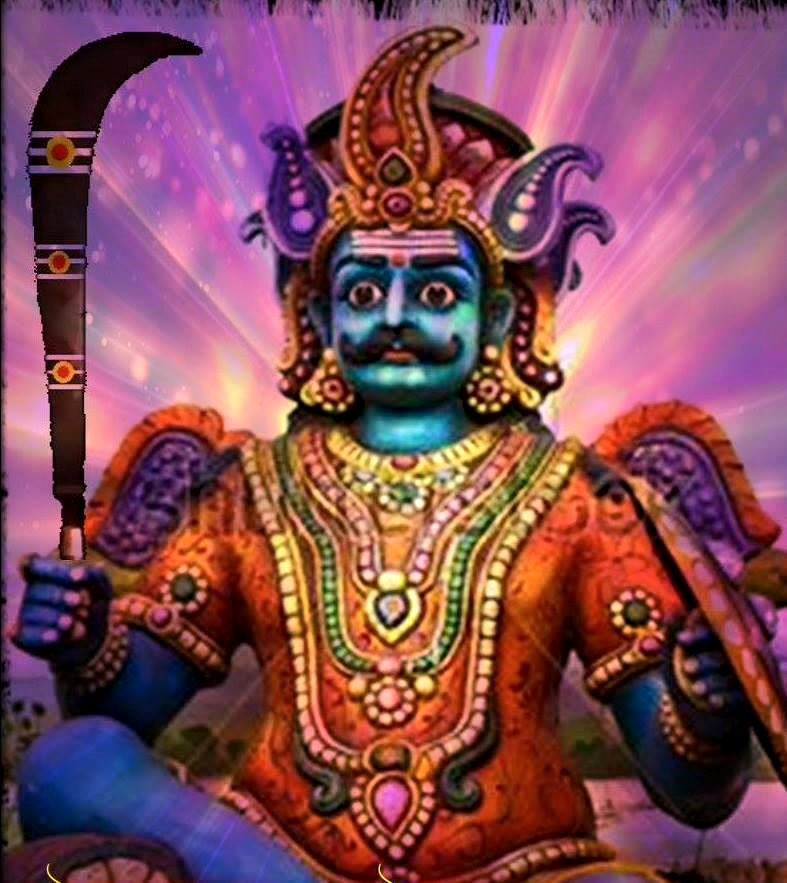
Karuppasamy, literally known as The Dark God, is a fierce-looking deity sporting a thick moustache, decked with many ornaments, riding a white horse and carrying a drawn-out sword.
He is said to have sprung from Vishnu’s hands and hence is also known as Kaiyannar (One created from the hand). Though, he has been around from time immemorial, he is hardly known in the Vedic Hindu Pantheon, and is popular as a village deity.
In fact, Karuppaswamy is a Universal God known to different ancient civilizations and called by various names.
Historical Tradition
In the ancient Tamil society, people venerated the Veerargal (or warriors) and had the formless stones (Veera Kal or Veerakkal) or Nadukkal erected in memory of them. These fallen warriors or any persons who sacrificed their life for a good cause such as protection of the welfare of the society or the community are revered by all. Just like other sub-deities, he is also a martyr.
Karuppanar is believed to protect the poor, and ensure justice and self-discipline among his believers. It is also believed that He is a fierce warrior who never forgives those who sinned or those who commit crimes. It is believed that He shoos away all evils and devils from entering the village. He masters all land and is a warrior who blocks all evil entering a boundary.
Typical Shrine
.jpg "18m padi karuppasamy mp3 songs free, download naa")
The Karuppanar Kovil (or a shrine) is always found in the outskirts of the village. The maintenance of the temple is taken care of by the whole of the village. His temple is usually in the open space and will not have traditional Gopurams like any other temples. You can see big statues of Gods with weapons like bow and arrow, swords, knives and other protective weapons alongside Karuppusamy.
There will also be statues of other Goddesses (7 Kannimaar or the 7 Virgins)called as saptha Kannimar in his temples. Animals, often signifying his pets – a dog (Vettai Naai or a hunting dog), a lion and his ride – the white Horse are also found.
Statues of Karuppusamy are often black in colour and adorned with chains. He will usually be holding a sword, sometimes with bells attached. Often, as part of his worship, a cigar will be lit and placed in the Deity’s mouth. He is also offered alcohol. He sports long hair that is tied sidewards on the head and has a thick mustache. His eyes are wide and bright, and the forehead is smeared with thiruneeru (sacred ash) and kumkum paste.
Karuppusamy is often worshipped alongside Madurai Veeran and Muneeswarar. The most famous temple for Karuppasamy is located at Azhaghar Koil, near Madurai. This is considered as the most important of the Karappannaswamy temples. Here he is worshipped as Pathinettampadi Raja Karuppannaswamy. There is no idol here. Only an Aruval at the top of eighteen steps. hence the name Pathinettampadi.
Worship of Lord Karuppasamy
The worship pattern is non-Vedic or non-Agamic through Folk tales, Folk songs and Folk arts (Villu pattu, Karagam, Koothhu, etc.). The local priest might offer flowers or Vibhuti (holy ash) or Holy flowers to the worshippers and may play the role of an oracle for Shamanism.
Various persons within the clan system are identified to play to the role of oracle on annual turn basis. They undertake vradham and maintain chastity and purity during the period of vradham. During the festivals, oracles get into trance state (Saami aadudhal) and deliver counselling messages to the group assembled there without bias.
The normal problems addressed are family problems, financial troubles and local community and social issues for resolving within the community group with the agreement of local ancestral god through oracle.
Whenever the wishes of the people are granted, they give their offerings to Him based on what they vowed to offer. There are rigidly no rules as to what a devotee can offer. The most common offerings include milk, camphor, rice, butter, cloves, ghee, cheroots, and alcohol. As mentioned earlier, animals like goats, pigs, and chicken are also sacrificed.
Forms of Lord Karuppana Swamy
God Karuppaswamy is worshipped in various forms, and different names are being given to him based on it. Apart from the difference in the weapons and the way Karuppaswamy stands or sits, there are not many differences in these forms.
It is believed there are 108 forms of god Karuppaswamy. Of those 108 forms, here are some of the popular ones.
- Padinettam Padi Karuppaswamy
- Sangili Karuppaswamy
- Sandana Karuppaswamy
- Sandana Karuppaswamy
- Periya Karuppaswamy
- Chinna Karuppaswamy
- Ellai Karuppaswamy
- Muthu Karuppaswamy
- Malai Karuppaswamy
- Vettai Karuppaswamy
- Thoppu Karuppaswamy
What does Karuppaswamy represent?
Karuppaswamy is a primordial God with tremendous amount of wisdom and energy. He is also called as The Dark God in reference to his role in driving away the dark forces of evil, falsehood and treachery
Within the Hindu tradition, he embodies the combined power of Kala Bhairava, Narasimha, Veerabhadra and Rudra.
Karuppaswamy is the God of Righteousness, who upholds ‘Dharma’ or Right Action. He embodies the energy to carry out prayers in a relatively short period of time, and in some cases, almost immediately. He has the ability to bring desired results very fast. His speed comes from the horse he gallops upon. As per Dr. Pillai, the horse is a powerful representation of the divine and has the ability to not only store one’s prayers, but also transmit divine vibrations.
Karuppaswamy can remove the pain and suffering of people, and establish a new divine world order of truth and righteousness. He represents the ability to manifest and produce fast results.
Dr. Pillai has also observed that the fastest and easiest way to connect to this archetype is by feeding the poor and hungry.
Parallels between Kalki Avatar and Karuppasamy
The Kalki archetype, or Avatar is said to be the tenth incarnation of Lord Vishnu. He is said to come to end the present age of darkness and destruction, he is the god who leads us through this transition to the Golden age.
The name ‘Kalki’ is metaphorically linked to eternity or time. The origins of the name bring in the meaning ‘Destroyer of Foulness,’ ‘Destroyer of Confusion’, ‘Destroyer of darkness’ or ‘Annihilator of ignorance’.
The representation of justice and righteousness is very similar to that of Karuppasamy. Destroying evil, bringing in justice, the Bhagavata Purana states, “Lord Kalki, the Lord of the Universe, will mount his swift white horse Devadatta and sword in hand travel the earth exhibiting his eight mystic opulence’s, destroying all evil,”- the roles of both the deities are similar and parallel to one another.
Both these archetypes represent the path towards destroying the old negative habitual patterns towards the path of a new era. They are the guiding lights of transition from this age to the new Golden Age.
Personal Practices
18m Padi Karuppasamy mp3 songs free, download Mp3
Chant the Mantra (Quantum Sound Frequency) given by Dr. Pillai to invoke Karrupasamy’s blessings and grace in your life.
Enga Karuppasamy Song Free Download
Gameshark pokemon rojo fuego ingles. OM KALKI KARUPPASAAMYAI VIDHMAHE
18m Padi Karuppasamy mp3 songs free, download Pagalworld
DASAAVATAARAAYA DHEEMAHI TANNO AADHI SIVAAYASYA AADHI AADHI PRACHODAYAAT OR KLEEM HAAM SWAHAGet a Shiva-Shakti mala, made from rudraksha/crystal beads, and chant this frequency 108 times daily.